Kataria Tech Zone
When a woodworking or manufacturing business starts shopping for a CNC machine, almost every conversation begins and ends with one number: the purchase price. It’s the figure on the quotation, the number that gets compared across three or four suppliers, and — for most buyers — the number that decides the deal.
It’s also the wrong number to base a decision on.
The purchase price of a CNC router, laser machine, or panel saw is only the entry fee. What actually determines whether that machine makes or costs you money over the next five to ten years is its Total Cost of Ownership (TCO) — the full picture of what it costs to buy, run, maintain, and eventually replace. Two machines with an identical sticker price can have a TCO that differs by lakhs of rupees over their working life, and the cheaper machine on day one is very often the more expensive one by year three.
This guide breaks down exactly how to calculate TCO for a CNC machine, what running costs most buyers underestimate, and how to use the number to make a genuinely informed purchase decision.
Why Purchase Price Alone Is a Misleading Number
Purchase price feels like the safest number to compare because it’s the only one that’s fixed and known upfront. Running costs, by contrast, are spread out, variable, and easy to defer thinking about — which is exactly why so many businesses get burned by them.
Consider two CNC routers priced within 10% of each other. One uses a lower-cost spindle and imported control electronics with limited local service support. The other uses a more robust spindle and is backed by a manufacturer with regional service centers and readily available spare parts. On paper, the cheaper machine looks like the better deal. In practice, if it needs more frequent servicing, longer downtime waiting for parts, or a spindle replacement two years earlier than the alternative, the “savings” disappear — and then reverse.
This is precisely why choosing the right CNC router for your woodworking business has to go beyond comparing quotations. TCO is the framework that forces that broader comparison.
What Total Cost of Ownership Actually Includes
TCO is best thought of in three phases: acquisition, operation, and end-of-life.
1. Acquisition Costs
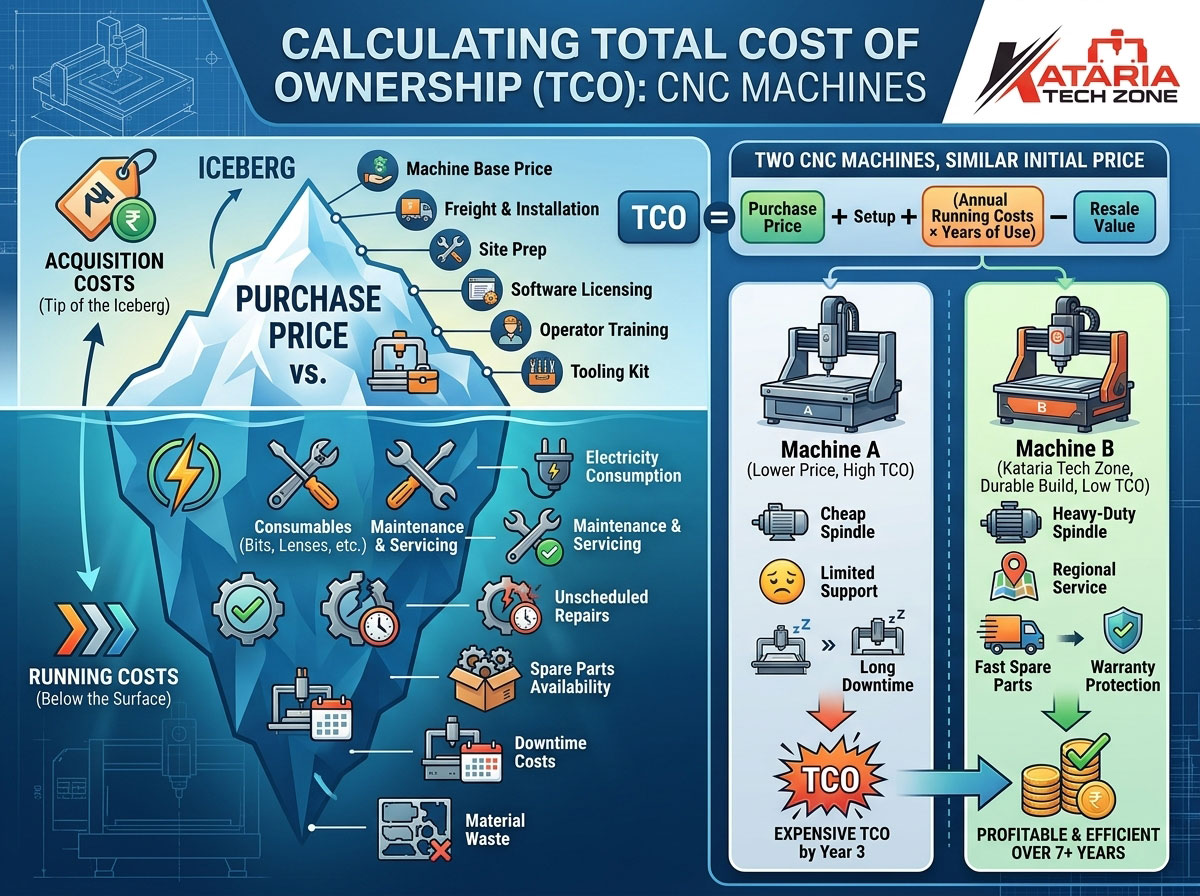
This is more than just the machine’s price tag. It includes:
- Base purchase price of the CNC router, laser machine, or panel saw
- Freight, transport, and installation — especially significant for heavier gantry-style machines
- Site preparation — electrical upgrades, flooring, dust extraction infrastructure, compressed air lines
- Software and licensing — CAD/CAM software, nesting software, control software updates
- Operator training — either included by the manufacturer or an external cost you’ll need to budget separately
- Tooling — router bits, laser lenses/nozzles, saw blades, and the initial tooling kit needed before the machine can run production
Buyers frequently price only the first item and are caught off guard by the rest, which can add 10–20% on top of the quoted machine price.
2. Operating Costs (The Part Everyone Underestimates)
This is where TCO calculations live or die, and where the real gap between two similarly-priced machines usually opens up.
Electricity consumption. Spindle power, laser wattage, vacuum table pumps, and dust extraction all draw power continuously during production. A machine with a larger or less efficient motor can add meaningfully to your monthly electricity bill, especially running multi-shift production.
Consumables. Router bits wear down and need regular replacement; the wear rate depends heavily on spindle quality and the materials you’re cutting. Laser machines consume lenses, nozzles, and assist gases. Panel saws go through blades. These are small individual costs that compound fast at volume.
Maintenance and servicing. Scheduled maintenance — lubrication, alignment checks, belt and rail servicing — keeps a machine running at spec and prevents expensive breakdowns. Unscheduled maintenance, when it happens, costs far more: parts, labor, and the production time lost while the machine sits idle.
Spare parts availability. This is one of the most underrated cost drivers. A machine backed by a manufacturer with local stock and fast turnaround on spares might lose you a day of production during a repair. One reliant on imported parts with long lead times can lose you weeks. Multiply lost production days by your daily output value, and the “cheap” machine can become the costliest one in your shop.
Labor and skill requirements. Machines that are harder to program or operate may need a more skilled (and more expensive) operator, or more training time before they’re production-ready. This connects directly to the points covered in Essential Features of Modern CNC Woodworking Machines — ease of use is a cost factor, not just a convenience.
Material waste. A machine with poor nesting software or less precise cutting will waste more raw material per job. Over a year of production, that waste adds up to a real, calculable cost — and it’s one of the reasons what specific features of panel saws boost cutting speed and accuracy matters as much for cost control as for output speed.
Downtime cost. This is the most overlooked line item of all. Every hour a machine is down for repair or servicing is an hour of lost production capacity. If your shop runs on tight order timelines, downtime doesn’t just cost repair fees — it costs missed deadlines and, potentially, lost customers.
3. End-of-Life Costs
- Resale value — machines from established manufacturers with good reputations tend to hold resale value better
- Decommissioning and removal costs
- Upgrade or replacement cost when the machine reaches the end of its productive life
A Simple TCO Formula You Can Use
While every business’s numbers will differ, a workable TCO formula looks like this:
TCO = Purchase Price + Installation & Setup + (Annual Operating Costs × Expected Years of Use) + Total Downtime Cost − Resale Value
Where Annual Operating Costs = Electricity + Consumables + Scheduled Maintenance + Average Unscheduled Repairs + Labor Premium (if any) + Material Waste Cost
Run this calculation over a realistic machine lifespan — typically 7 to 10 years for a well-built industrial CNC machine — and divide the total by the number of years to get an annualized cost. That annualized figure is the number that actually tells you what a machine costs your business, not the number on the quotation.
A Practical Example
Imagine comparing two CNC routers, both priced around ₹9,00,000:
Machine A has a lower listed price of ₹8,50,000, but uses a lower-grade spindle, has limited local service support, and a manufacturer warranty of one year.
Machine B is priced at ₹9,20,000, uses a heavier-duty spindle, comes with a manufacturer offering regional service support, and a longer warranty period.
If Machine A needs a spindle replacement in year 3 (a cost that can run into lakhs, plus lost production days waiting for the part), while Machine B runs without major component failure through year 7, the “cheaper” machine ends up costing significantly more over its working life — even before accounting for the extra downtime it causes along the way.
This is the exact gap TCO analysis is designed to expose, and it’s why serious buyers evaluate machinery the same way they’d evaluate any other major manufacturing investment: on lifetime cost, not sticker price.
How to Reduce TCO Before You Even Buy
- Ask for real running-cost data, not just specs. A reputable supplier should be able to tell you typical power consumption, consumable life, and average service intervals for the specific model you’re considering.
- Check spare parts availability and lead times up front. This single factor can be the difference between a two-day repair and a two-week production halt.
- Prioritize build quality on high-wear components. The spindle, linear guides, and rails are where cheaper machines cut corners — and where the long-term cost shows up first.
- Factor in warranty and after-sales service coverage, not just as a comfort feature, but as a direct cost-reduction factor.
- Right-size the machine to your actual production needs. Oversized machinery for your current volume increases both acquisition and running costs without proportional benefit — something worth revisiting alongside Top 7 Machinery Upgrades Every Woodworking Business Needs to Scale Production as your shop grows.
Why TCO Matters More as You Scale
For a small shop running a single shift, the gap between two machines’ TCO might be manageable. For a manufacturer running multi-shift production across several machines, that same per-machine gap gets multiplied across the whole shop floor — turning a marginal cost difference into a significant line item on your annual budget.
This is also why TCO thinking pairs naturally with decisions like maximizing workshop ROI when choosing between a vertical and horizontal panel saw — every major machinery purchase in your shop should be evaluated on the same lifetime-cost basis, not in isolation.
Final Word: Buy the Machine, Not the Price Tag
The purchase price of a CNC machine tells you what you’ll pay once. The Total Cost of Ownership tells you what the machine will actually cost your business over its working life — in electricity, consumables, maintenance, downtime, and the productivity you gain or lose along the way. For a capital investment that will sit on your shop floor for the better part of a decade, that’s the number worth getting right.
At Kataria Tech Zone, we build our CNC routers, panel saws, and laser machines with exactly this lifetime-cost thinking — durable components, locally available spare parts, and after-sales support designed to keep your TCO low, not just your purchase price. Explore our range of CNC router machines, panel saws, laser machines, and woodworking cold press machines, or get in touch to talk through the TCO of a machine for your specific production needs.